The Colonel’s First Story

Readers constantly remark that Clarence J. Birdwhistle is their favorite character.  I’m always happy to hear this because frankly, he’s my favorite as well.  Ironically, my initial concept for the book portrayed him as a complete and utter fraud.  After developing him and integrating him into the little town however, I decided I liked him too much for him to be anything but the kind, respectable gentleman he seemed to be.  So the theme of the book took a drastic shift and I’m glad.

Colonel Birdwhistle hails from Chelmsly, England, but joined the British Army in his youth and spent his entire career in colonial Africa.  After his retirement from the service, he left England on a whim and ended up in Portsong, Georgia.  A lifelong bachelor, he had never spent much time around children.  But with the increase of his celebrity as the exotic stranger in the quiet town, he suddenly became very popular among the youngest crowd.

Over the next several weeks, I will be presenting an excerpt from Virgil Creech Takes a Swipe at Redemption, in which the Colonel makes his storytelling debut from his favorite yellow bench.

Colonel on bench

“Excuse me,” interrupted the voice of a lady to his right.

Being a gentleman, the Colonel rose instantly.  On the way up he opened his eyes and coughed to regain his voice, “Hello, madam.”

“Excuse me, but I’m Mrs. Dobrey and I believe we met at the Ladies Tea just the other day,” said the lady.  “Colonel Birdwhistle, isn’t it?”

“Quite right, ma’am,” he replied with a bow.  “It is a pleasure to see you again.”

“Why thank you, sir.  I was absolutely fascinated by your stories,” she said.  “I have always wanted to travel abroad and see some of the things you talked about.  To think, you’ve sat in Europe and Africa, while I’ve never left this state.  It’s a fine state and a fine place, don’t get me wrong, but I should like to see something outside of it some day.  That’s not wrong, is it?” she said without leaving the slightest pause for answer.  “I mean if one wants to travel, it doesn’t mean that there is something wrong with the place she lives.  It just means that there are more interesting places to be.  Excuse me, I didn’t mean ‘more’ interesting.  That was a mistake.  I only meant that there are ‘other’ interesting places.  Yes, that’s it.  Other interesting places.  Don’t you agree?”

The Colonel said he did, but really didn’t know what he was agreeing with.  While she talked, he was able to take in the thin lady in front of him.  She was really somewhat of a mouse actually — very small with round glasses perched on an active nose.  Every time she talked, the glasses bounced on her face, and it seemed that they were rarely still.

“I love Portsong, I really do,” she continued.  “There are all sorts of fine things to be seen here.  But Africa.  It really flutters the mind, doesn’t it?  All of the animals and the danger.  It’s really quite romantic to ponder.  You must have had wonderful adventures while you were there.”

“Why yes…” he started to say but was cut short as the glasses leapt again.

“There isn’t much adventure here,” she continued.  “But it is a fine place, really.  Such a fine place.  I wouldn’t want to be from any other place in the whole world, if you ask me.  But I would like to hear more about the places you’ve been.  Actually, I was telling my boy, Leon about you just the other day, and he said he would love to meet you.  Do you mind if I bring him over here?”

“Of course not, madam,” he replied.  But she was already gone.  She was a fast little mouse.

Part 2

The Only Sled in Town

sled boyThe one and only sled in Portsong belonged to Johnny DeLongo and sat idle for most of the first year he lived in town.  His father, Marco, a genius at research, had moved the family down from the Bronx after accepting the position of head engineer at the Swanson Glassworks.  Acceptance into Portsong life was not reciprocated for the youngster, who found himself different at every turn.

On his first day of school, he mistakenly assumed everyone was a Yankees fan and hailed Babe Ruth as the greatest baseball player of all time.  Little could he know that Ty Cobb was a local hero from a town nearby and the radio station serving the Portsong area in 1926 broadcast only the Detroit Tigers.

His thick New York brogue did nothing to aid his prospects.  He had to repeat himself every time he offered an answer to the teacher, prompting snickers from his classmates.  He was constantly told to slow down or just stared at with blank faces when he tried to speak.

The place he felt most different was church.  Raised a good Catholic, Johnny had no idea what to make of his first service at the Goose Creek Country Church.  Instead of a robed, tranquil priest crossing himself and speaking Latin, Johnny sat in the hard pew and watched the antics of the animated Reverend Josiah Crane.  The poor child decided the preacher was speaking some strange derivative of English while he slapped the pulpit, waved his arms, wailed loudly, and pounded out his sermon.  When the piano began playing, I Surrender All, Johnny was ready to surrender whatever necessary to get out of the old, stuffy church.

But his misfortune changed on the first day it snowed.  The white stuff surprised the other boys, but seemed ordinary enough to Johnny, who retrieved his trusty Flexible Flyer from the cellar and joined the marching boys headed toward Curaban Point.  He fell in line next to the only boy who had tried to be nice to him thus far – a boy name Henry Lee.

“What’s that thing?” Henry asked

“Itza sled,” Johnny replied, looking at the scrap of tin the boy held.  “Ain’t you got one?”

“No,” lamented Henry.  “It’s never snowed before.”

“What?” cried Johnny, wondering what that could possibly mean.

“Not since I’ve been alive,” Henry said matter of factly.  “Is that thing fast?”

“Sure is! Gave the ruddahs a fresh coat a wax this morning.  It’ll haul!”

Johnny’s tempo had picked up in his excitement and Henry didn’t quite understand him, but he let it go.  The two plodded along, talked, laughed, and genuinely enjoyed each other’s company until they reached the summit of the hill and found Virgil Creech waiting with an old shovel to ride.

“Hey-ho, Henry,” he called to his friend before turning his nose up at Henry’s company.  “Whatcha doin’ with him?”

“He’s okay, Virgil.  Just new here.”

Virgil looked the new boy from head to toe, his eyes finally coming to rest on the red metal and polished wood of the sled.  “What’s that thing?” he asked.

Johnny laughed, still surprised at these boys and their ignorance of sleds.  “Itza sled.  You wanna take it down?” he offered.

Virgil’s eyes grew wide, “Ya mean it?”

“Shoo-wah, climb on,” replied Johnny as he slid the rudders into place on the powder.

Virgil discarded his shovel and was belly-down on the sled in an instant.  With a slight push he left behind only a glee-filled scream for the others on top of Curaban Point.  Every boy on the hill gathered around as Virgil trudged back up with sled in tow.  He merrily answered a dozen questions about the ride and hesitantly offered the sled back to Johnny, who didn’t take it.

“You wanna go?” Johnny asked Henry.

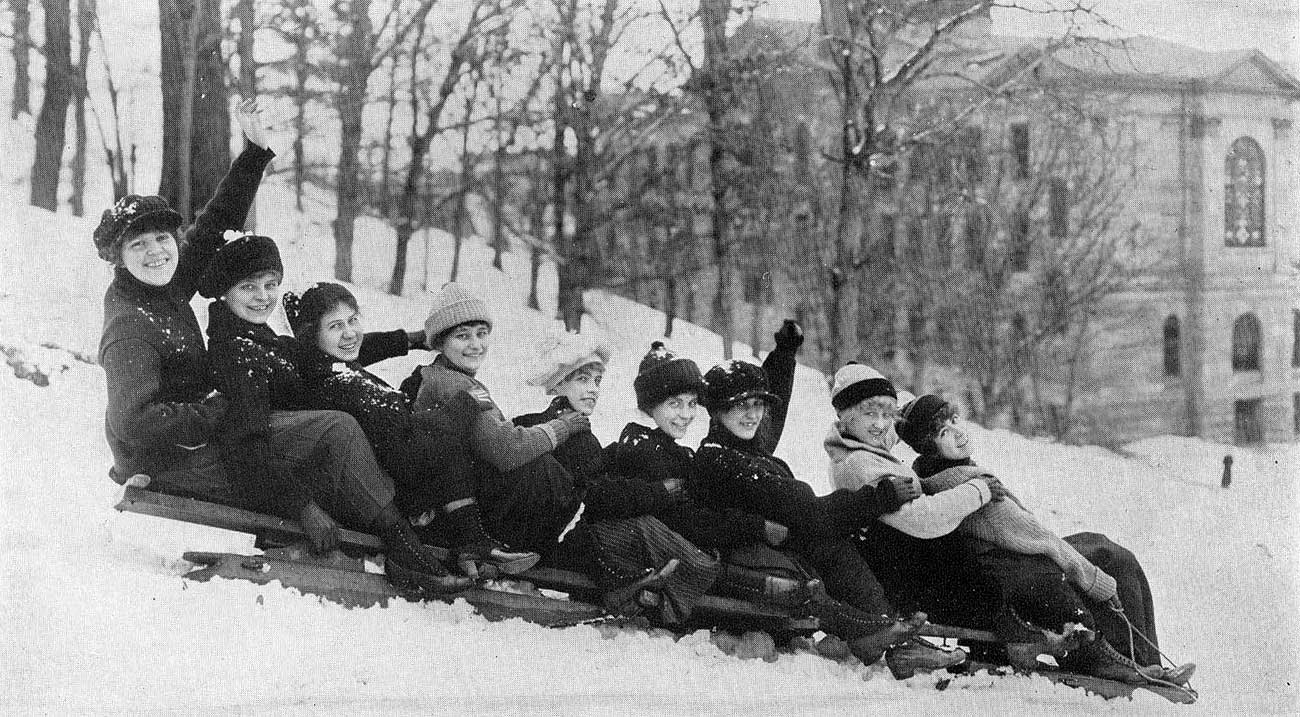
sledding_largeHenry took him up on the offer, as did every other boy present.  In fact, Johnny never got to touch the sled that day, but enjoyed the acceptance as the Portsong boys looked past his newness for the first time and realized he was just a kid, like them.  Even Virgil decided he liked this new kid, no matter how funny he talked.

If only grown-ups could come together so easily over a trivial thing such as the only sled in town.