What to Say When There is Nothing to Say

As a victim of a poor memory, I remember only flashes of our first weeks in the hospital. Visits, conversations, tears, rooms, tests, scans – they all run together in my cloudy mind. There is, however, one event I recall with perfect clarity.

He texted to ask if it was okay if he stopped in on his way home from work. I wasn’t sure we needed a visitor, but Kylie agreed. Freshly diagnosed with Ewing’s Sarcoma, we were in the pediatric cancer wing where Kylie had begun her first round of chemo. By the time he arrived, our patient was sleeping and I got up to greet him quietly. I remember he put his backpack against the wall and opened his arms to hug me.


I am not a hugger…

This is weird…

He’s here for Kylie, not me…

Do I hafta???  Why????

I’m okay, I don’t need this…

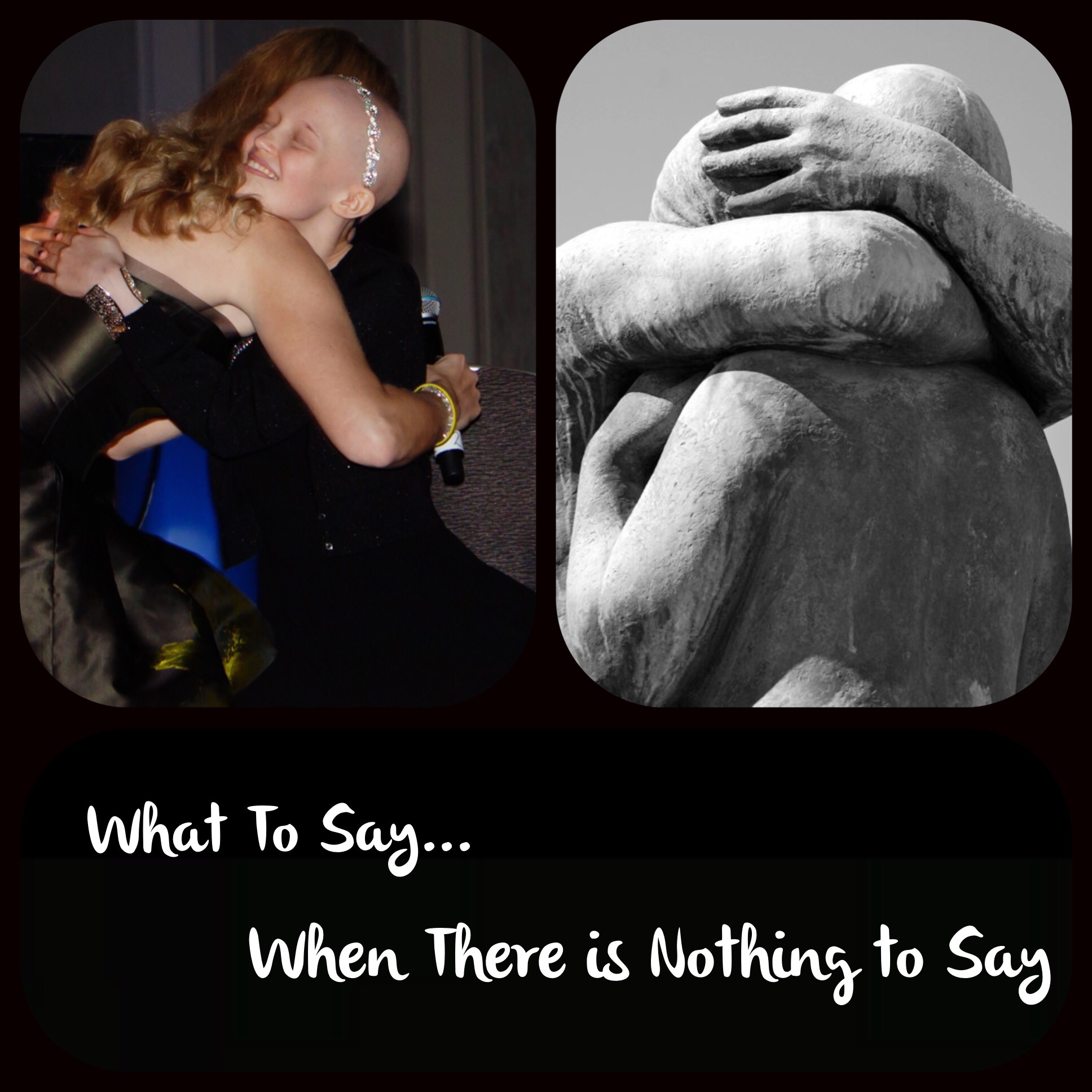
Not a word was spoken and I promptly fell apart in his embrace. I cried like I had never cried in my life. He just held on for the ride.

*     *     *


What my friend Steve gave me that day was the very essence of what to say when there is nothing to say:

Love


Love is all there is. It can speak volumes without an audible syllable. It can be felt in a quiet room where words aren’t welcome. It might be simplistic, but love is all that can break through the hard shell of pain and fear after a parent has heard the dreadful phrase, “your child has cancer.”

Let me say again, there are no magic words that instantly sooth, but here are some things that resonated with me when Kylie was first diagnosed:

1. An expression of regret – “This really sucks” (or “stinks” for the less crass. But I assure you, it does suck!)

2. A profession of love and friendship. How do you say that? Um… “I love you.” For those uncomfortable with the ever-personal “I”, you can always lean on the family crutch for support and say, “We love you guys.”

3. Presence. “I’m here.” There are few positives in having a child with cancer, but one is that your calls rarely go to voicemail. Availability can be sensed. I knew very little in those traumatic first weeks, but I knew who was there for me, and I called on them when needed.

4. A promise of endurance. There is a long road ahead of the family. Like anything, many people with good intentions begin the fight full of fervor but life gets in the way. No judgments here, I get that. A promise such as, “I am here today, tomorrow, and in six months,” means a lot when given sincerely.

5. A specific offer of assistance. Sometimes, this isn’t even verbal. If you see a need, meet it.

  • We once came home to find a huge painted pot full of yellow flowers on our porch.
  • Sometimes our lawn just got mowed.
  • A woman who bakes incredible cookies would just stash dozens in our mailbox without a word.
  • Friends organized meal calendars, ballet rides, and school carpools for our other daughters.

This is the action side of love. Love does! Love molds unique talents into lavish gifts. Doing love doesn’t have to be grandiose or expensive and is often best when anonymous.

6. An assurance of prayer and/or positive thoughts. To know that my little girl was on the forefront of people’s minds was huge. Knowing that children included Kylie in their nightly bedtime prayers was humbling – especially when my prayers couldn’t get past a groan and balled fist.
 

image


Nobody knows what to say to the parents of a child diagnosed with cancer. We didn’t know what to say or what we wanted to hear – it was uncharted territory we’d rather not have explored. I assure you we were glad to not be travelling alone. If you have friends who find themselves on this heartbreaking voyage, I would urge you not to be afraid to approach them. Just step out in love, the right words will come. You might start with a silent hug. Even the bristliest of us cancer parents could use a hug from time to time.

What Not to Say When There is Nothing to Say

Recently, I was asked for advice about how to respond to the parents of a child diagnosed with cancer. Let me say from the outset that I am a dubious source whose council typically causes some manner of regret. However, since I have stood on the receiving end of some pretty stupid comments over the past year, I do have a fair amount of expertise in this particular area.

First, THERE ARE NO MAGIC WORDS, so don’t try to find them. When one is at the start of a long, twisted road that includes the potential mortality of their child, words simply cannot soothe. They can, however, aggravate. So I thought it might be helpful to look at some things that struck us the wrong way when we were facing our crisis.


IMG_0601


1. Do not equate anything you’ve gone through (or had a third cousin go through) with their situation. This is an immediate conversation ender. We once had someone compare a month-long sinus infection to Kylie’s cancer.

2. One of the most frequent things we heard was, “What can I do?” No matter how sincere the offer, this can add stress to an already stressful situation. The parent of a recently diagnosed child has no idea what day it is or if they remembered to change their underwear for the past two weeks, so they will most likely have trouble assigning tasks to the three dozen people who have asked. Vague offers of help only muddle already murky waters.

3. By far the worst statement I got was, “I know how you feel.” Uh, no you don’t. Get back to me when you watch the rise and fall of your child’s chest wondering if it will stop during the night. And even if you have been there, your feelings and mine are totally different things.

4. Watch your quantity of words. Parents in this situation have a maximum amount they can absorb before they shut down. Docs usually fill that bucket daily.

5. Persistence can be irritating. There were weeks that passed when we just couldn’t answer texts and emails. It didn’t mean anything other than we were focused on greater issues. A second or third text reminding us of the original only made us feel bad for our inability to balance everything.

6. Don’t expect to assume a role that you didn’t have before diagnosis. If we haven’t spoken in years, I likely have someone else to bare my soul to. It is fine to offer especially if you have dealt with similar issues, but don’t expect it.

7. Don’t badger for information. We would have loved to have known specifics, time frames, and end dates. Unfortunately, these often don’t exist in the cancer game and constant demands for information only serve to remind a parent of their helplessness.

8. If you made an offer that wasn’t accepted, please understand it may be wanted or needed and simply came at the wrong time. Don’t be offended or press for an answer. If the parent needs it, they will most likely return to it eventually.

9. “No” is a perfectly valid answer that people must be prepared to accept without justification or hurt feelings. The parents do not need added drama in their life and shouldn’t be forced to manage the emotions of others.

10. With all of the fears and doubts of such a diagnosis swirling in the parent’s mind, a mention of God’s Will can be a very slippery slope. While we are believers, religious platitudes were not extremely helpful and I can only imagine how such words would be perceived by someone who isn’t a believer.


*  *  *  *  *


This list is not exhaustive and I can only speak for my family. I think you will find it interesting that while we experienced all of the above, not a single cancer family ever did any of them. Never.

I would guess that this list could apply for other health or traumatic situations, but I can’t speak to those since I have only navigated the pediatric cancer waters. (Look at me, trying to follow my own advice!)


Next week I will give some suggestions of things to say when there is nothing to say.